The Second Symposium on Generative AI in Education and Research
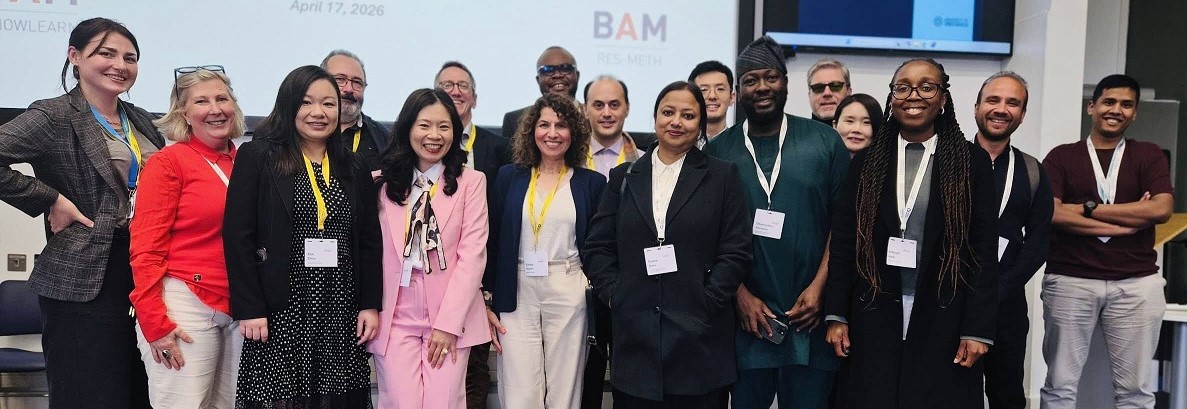
On Friday 17th April 2026, at the University of Greenwich, we hosted the The Second Symposium on Generative AI in Education and Research. This day turned out even better than I expected, with one key message coming through again and again: AI is an amplifier, nothing more nothing less. It is only as good (or bad) as the user. It was great to see some more refined argumentation, and even some new considerations coming - particularly from our audience, who really did ask the best questions!
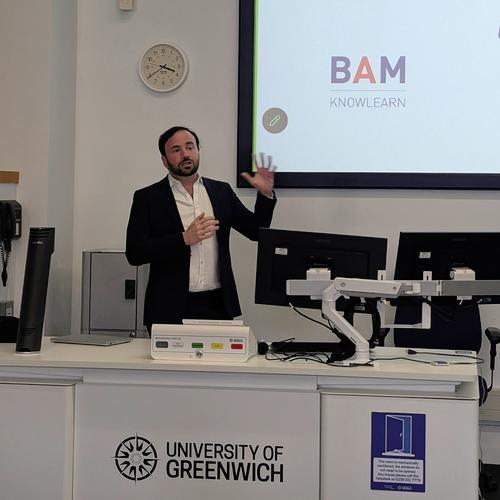
We started off by hearing from British Academy of Management's (BAM's) own CEO Jack Harrington who highlighted why this work is so important, how BAM has approached questions of GenAI in Education and research, and the practical ways in which BAM could help our delegates develop their ideas further, for example, by writing a case study, getting involved with the new Business Research Unpacked or even by going for management publication of the year.
The morning panel, chaired by Dr Maria Jesus Jerez Jerez- PhD, MSc, SFHEA, CMBE,ICHRIE saw the sometimes opposing views of Professor Xue Zhou and Savvas Papagiannidis on the education panel which, for me, really embodied much of the current debate- on one hand, AI is to be embraced and can teach criticality and teach a need to produce tangible outputs to stay competitive in the employability market; on the other hand, AI amplifies issues that were already there, and makes them ever more pressing to solve: AI shows us what's wrong with higher education- among other things. This message - that AI is amplifier, was the same story that was told by our morning key note Mark Saunders - that AI could be a devil or an angel, a tempter or saviour. As a wise man said - adding AI to a stupid person (or unethical person) does not make them smart (or ethical), it just amplifies what is already there...
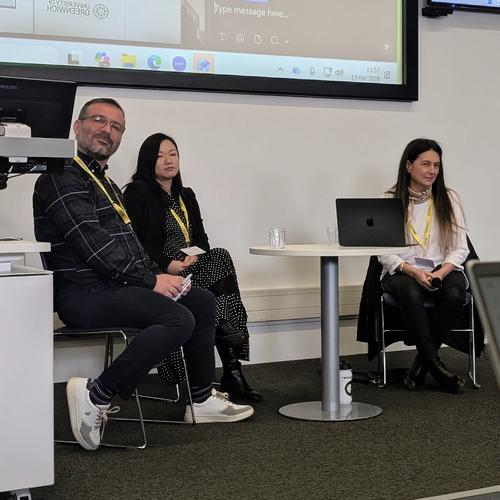
Morning Panel: Generative AI and the paradoxes in management education - Prof. Savvas Papagiannidis, Prof. Xue Zhou and chair, Dr Maria Jerez Jerez
We then had some absolutely fantastic parallel paper sessions delivered:
🔷 Olumuyiwa Abiodun FHEA talked to us about how the literature tells us to balance the brain with bot, integrating pedagogical theory like constructivism with theories on technology and innovation. We saw Peter Iduh Ogwuche, Ph.D, FHEA, FCTI, CMBE offer an alternative integration of theories, drawing on primary research and institutional policy to make recommendations on how to practicality address AI in education.
🔷 Moving over to the next room, we saw Federico Ruggiero explain how they've been using GenAI to help student's experiential learning and understanding of fundamental concepts in digital marketing. Adaugo Isaac presented a synthesised and critical analysis of AI in education, with a call for educators to focus on their own development in order to support the development of their students.
🔷 Elivelton Da Silva Fonseca talked to us about their use of GenAI with interrupted time series modelling to examine how Covid-19 induced health care management collapse led to excess mortality. Albert Amanollahnejad drew on Strategic Leadership Theory to present a framework on accountability in AI adoption within institutions. Dr Gerhard Kristandl demonstrated how he uses GenAI with (most importantly, as we heard from others throughout the day) a-human-in-the-loop to create intricate and engaging assets for use in education. Think: rather than a 6 pages of 12-pt text case study to be printed and read, a whole functioning company website which student's explore and navigate to solve a problem.
And then, after lunch, we were treated to two more fantastic keynote talks. Dr. Tracy Tuten and Jack Bowen came to talk to us about Co-Loop, an AI-powered analysis platform for qualitative research emphasising that we are not using AI to think for us but as a tool to think with - that by increasing efficiency on some of the manual tasks, we can have more time and cognitive space for the deeper, interpretative thinking - that is, to answer the big questions. In the other room we had Alibaba's Yuefeng SUN who spoke about AI applications across industries and sectors from green logistics to healthcare and even for sign language!
During the afternoon parallel paper sessions:
🔷 Sujata Bose showed us how different inter-rater reliability is between humans and AI, Cloda Jenkins and Dr Nai Li demonstrated the great work being done at Imperial Business School to co-create with students AI literacy and support.
🔷 Laeticia Hau Fai Tseung shared with us student and graduate perspectives on future ready competencies in the context of AI. Giuseppe Bongiorno discussed a practice-informed analysis of a teaching experience designed within a working group of the Società Italiana di Management (SIMA) which foregrounded student awareness of AI, understood not as technical proficiency but as the capacity to critically assess the epistemic limits, assumptions, and implications of AI-supported reasoning in managerial contexts.
🔷 Finally, Marios Kremantzis PhD, SFHEA, CMBE, AFORS bought the conversation forward from GenAI to Agentic AI (which turned out to be excellent foreshadowing for the focus of our afternoon panel) and how it might empower students through intelligent tutoring systems, multi-agent simulations, and personalized content curation, bridging gaps in experiential learning, scalability, and ethical reasoning.
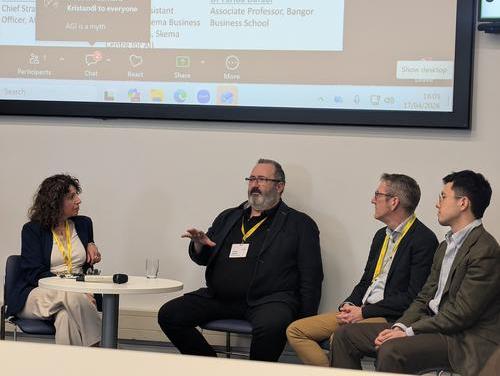
Afternoon panel: Generative AI and the paradoxes in management research - Dr Fariba Darabi, Prof. Viktor Dorfler, Mark Henderson, Dr Xule Lin.
For our afternoon panel, on Generative AI and the paradoxes in management research, we were joined by some very intelligent and industrious thinkers. Talking from industry, from long-time experience, and talking on Agentic AI, they highlighted new ideas and new issues to consider. Too much was covered in this panel to recount here. As one illustration: the chair, Dr Fariba Darabi guided the discussion, asking first what has significantly changed for our colleagues in the last 12-18 months. Mark Henderson BEng MBA and Xule Lin both spoke to us about the rising dominance of Agentic AI, with Mark emphasising also the need to have governance and ethicality built in from the very ground up- its too late to add it in as an after thought to the finished product. Viktor Dörfler bought us back to the argument of AI as an amplifier as he discussed the difficulties around an ethical AI - the problem is, you see, humans haven't worked out quite what it means to be ethical, even after thousands of years - so how can you train it in an AI without the instructions for ourselves?
And finally, the day closed off with Crystal Han-Huei Tsay offering a quick summary of the day before warmly inviting us to enjoy some wine and ham courtesy of our sponsors Ojos Foods and Zamora Company organised by Dr Maria Jesus Jerez Jerez- PhD, MSc, SFHEA, CMBE,ICHRIE.
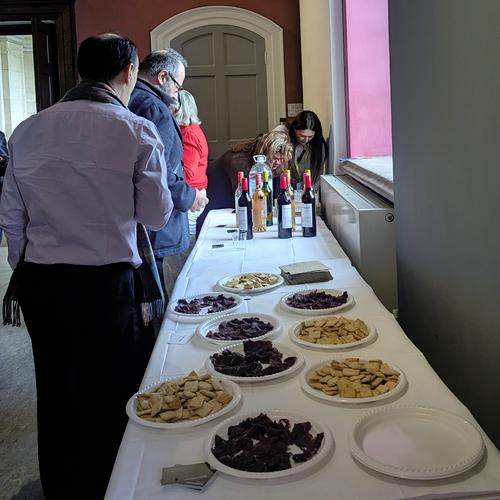
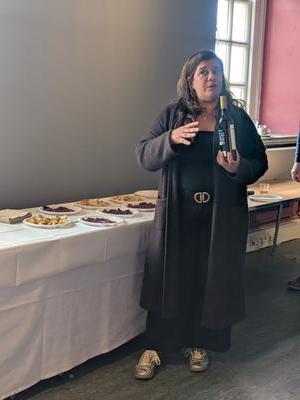
But the real point of this post was to give me an opportunity to give some thanks to everyone involved. This event run fully hybrid, with our online hosted in Canada- that's five hours behind UK time right?
So a massive thank you to Candice Chow 周 志 㯋 and Jan Klakurka, C.Dir., CPA, CA, MBA, CMC, APF, Dip.WSET for hosting the online component of the day - you did a fantastic job and the day ran as seamlessly as it could!
An extra special thank you here to Naira Stepanyan for volunteering to help out with the day- without you it would have not run as smoothly!
Thank you to the University of Greenwich for hosting - and for the security, porter's and catering team for the amazing work that you did; the day was delicious, comfortable, and joyful because of you.
Thank you to all the UoG teams behind the scenes - H&S, Freedom of Expression, HoS, etc, etc,.
Thank you. Thank you to Justin Brown from British Academy of Management for your endless support.
Thank you to all the presenters, panellists, speakers and guests - each of you made an invaluable contribution that made the day what it was.
Finally, a massive thank you to all my colleagues and friends who organised this event; Alexander Kofinas, Crystal Han-Huei Tsay, Dr Maria Jesus Jerez Jerez- PhD, MSc, SFHEA, CMBE,ICHRIE, Candice Chow 周 志 㯋, Jan Klakurka, C.Dir., CPA, CA, MBA, CMC, APF, Dip.WSET, Viktor Dörfler and Dr Fariba Darabi.