
e-Business and Information Systems Management
The e-Business and Information Systems Management SIG fosters and promotes the discovery and dissemination of high quality research at the interface between information systems and business management. Our rapidly growing international memberships include academics and practitioners at all stages of their careers.

About the SIG:
The E-business and Information Systems Management Special Interest Group (SIG) provides a vibrant interdisciplinary community for scholars, practitioners, and policymakers interested in the transformative role of digital technologies in organisations, markets, governments, and society. The SIG seeks to advance knowledge of how emerging digital technologies reshape business models, organisational processes, public services, consumer experiences, and broader societal outcomes.
The SIG embraces a broad range of topics and serves as a platform for discussing cutting-edge developments in areas including, but not limited to, artificial intelligence, machine learning, data-driven analytics, virtual and augmented reality, blockchain, Industry 4.0, smart systems, and digital platforms. Recognising the rapid pace at which the Information Systems (IS) field is evolving, the SIG welcomes behavioural, organisational, socio-technical, and design-oriented research traditions, including Design Science Research that contributes to the creation, implementation, and evaluation of novel digital artefacts and solutions.
As emerging digital contexts increasingly challenge assumptions embedded in existing theories, the SIG encourages theoretical development and refinement to explain new forms of interaction, agency, identity, trust, fairness, governance, value creation, and decision-making. In particular, the SIG seeks to advance understanding of contexts in which interactions increasingly occur between humans, AI agents, algorithms, digital platforms, virtual environments, and interconnected socio-technical systems.
Importantly, the SIG promotes critical reflection on the implications of digital technologies for organisations, individuals, communities, and the natural environment. This includes examining issues related to ethics, inclusion, sustainability, resilience, governance, and societal wellbeing.
The SIG aims to facilitate scholarly exchange across disciplinary boundaries and encourage collaboration between researchers, industry practitioners, and policymakers. In doing so, it seeks to foster a supportive research community that contributes to both academic advancement and practical impact in an increasingly digital and rapidly evolving world.
Objectives:
The objectives of the E-business and Information Systems Management SIG are to:
- Advance research and knowledge on emerging technologies and their design, implementation, management, and societal implications across business, government, and non-profit contexts.
- Encourage critical examination of the implications of emerging technology, such as ethical, social, environmental, governance, and inclusion-related challenges.
- Support member development through networking opportunities, research collaborations, mentoring activities, workshops, and dissemination of best practices.
- Foster an inclusive and collaborative research community that supports interdisciplinary dialogue.
- Facilitate engagement with industry, government, and society to maximise the practical impact and relevance of digital business and information systems research.
SIG Events 2026:

SIG Committee Members 2026


Dr Abhishek Behl
Abhishek Behl is a Senior Lecturer and Director, Internationalization at Keele Business School, Keele University, UK. He has earned his second Ph.D. from the Indian Institute of Technology, Bombay, where his research is in crowdfunding and gamification. He holds more than 10 years of experience in teaching, research, and consultancy. Abhishek is a fellow of the Spatial Data Lab at Harvard University, USA, and an Affiliate Member of the Gamification and Systems Thinking Lab at the University of Edinburgh, UK. He is the president of the Special Interest Group (SIG)- GAME of AIS. His research focuses on gamification, stakeholder engagement, business intelligence, sustainability, and e-commerce start-ups.
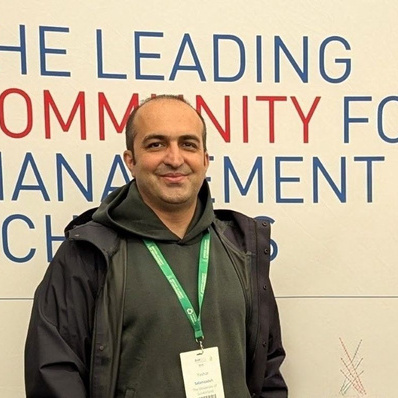
Dr Yashar Salamzadeh
Dr Yashar Salamzadeh (SFHEA, CMBE) is a PhD scholar in Management and currently works as a senior lecturer in digital business at University of Sunderland (UK), as MBA program leader, REF UoA lead, and “Digital Business, Sustainability and Society” research cluster lead and a research coach. He has published more than 170 research articles in international and national journals and conferences with more than 4900 citations. Yashar has the experience of 17 years of teaching in MBA and Master of management courses in five different universities in middle east, south-east Asia and Europe. He has supervised more than 100 MBA and master students, 12 doctorate students and is currently supervising 9 PhD students. He has led the launch of a new specialization for MBA courses and programs on “Digital Leadership”, “MBA in AI”, and “Digital Enterprise and Innovation” in different universities. Being a business consultant, and a certified coach, he has 12 years’ experience of management consultancy for different organizations ranging from SMEs to MNCs in different countries. He also has cooperated in more than 70 international journals as an editorial board member and review board member. He is also a member of British Academy of Management and UKVI ESRC peer review colleges. His fields of interest include Digital Business, Digital Entrepreneurship, Digital Leadership, Digital HRM, Digital Transformation, Green Business and Sustainability.
Scholar Google Profile: https://scholar.google.com/citations?hl=en&user=45Cb300AAAAJ&view_op=list_works&sortby=pubdate
LinkedIn Profile: https://www.linkedin.com/in/yashar-salamzadeh-phd-fhea-cmbe-7bbb7839/

Natalie Paleothodoros
Natalie is a Senior Lecturer in Organisational Behaviour, Theory and Technology at the School for Business and Society, University of York. She holds a PhD in Organisation, Work and Technology from Lancaster University Management School. Natalie's research interests are in taking ethnographic approaches to examining the constitutive role of technology and space in the organization of work, particularly in relation to new ways of working, AI and the digital age.


Adeyinka Abiola
Adeyinka Abiola is a PhD researcher at Newcastle University Business School, specialising in Information Systems and Operations Management. Her research explores how multicultural hospitality SMEs navigate operational complexities, manage demand uncertainty, and reduce food waste, with a particular focus on supply chain agility, digital technologies, and sustainable operations.
As the PhD and Social Media Representative for the British Academy of Management’s e-Business and Information Systems Management Special Interest Group (SIG), Adeyinka is committed to supporting doctoral researchers, promoting research engagement, and strengthening knowledge exchange and collaboration within the academic community.
SIG Community Pages

