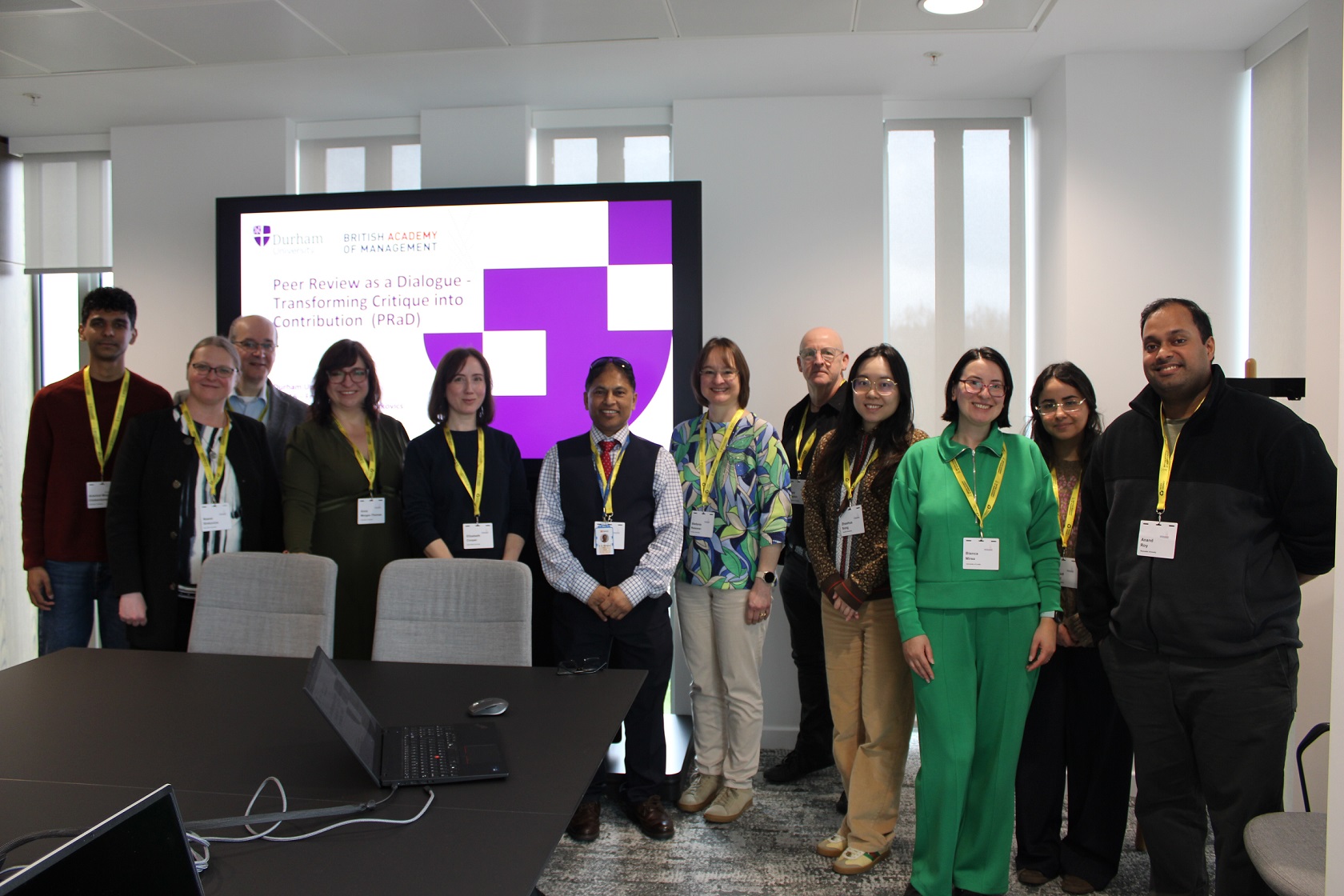

The BAM Peer Review College workshop, Peer Reviewing as a Dialogue: Transforming Critique into Contribution, co-organised through the BAM Peer Review College and hosted at Durham University Business School from 16 - 17 April 2026, brought together a clear and timely message: peer review works best when it is understood not as a gatekeeping exercise, but as a form of constructive academic dialogue.
Across the two-day programme, speakers offered distinctive and practical insights into how authors and reviewers can engage more developmentally with manuscripts and feedback. Prof Anna Morgan-Thomas (University of Glasgow) framed the peer review journey through a vivid “safari” metaphor, helping participants make sense of the emotional realities and editorial pathways of the review process. Prof Stewart Miller (Durham University) focused on quantitative papers, emphasising transparency, construct validity, methodological justification and the importance of making rigour visible in methods and results sections. Prof Stefanie Reissner (Durham University) addressed qualitative research, highlighting the need to review work in paradigm-appropriate ways and to resist one-size-fits-all assumptions about quality and rigour.
Prof Noemi Sinkovics (Newcastle University) showed how literature-related reviewer comments often signal not a simple citation gap, but a deeper issue of positioning, framing and audience relevance. Prof Martin Spring (Lancaster University) explored the challenges of reviewing across disciplinary boundaries, showing how valuable research can struggle when its contribution is not yet legible within a disciplinary “home”. Prof Rudolf Sinkovics (Durham University) concluded with a practical reminder of what good reviewing looks like in action: give the paper a chance, identify its promise, be specific, be ethical, and provide guidance that helps the work move forward.
Together, these contributions captured the workshop’s central ambition: to help scholars transform critique into contribution — and to strengthen peer review as a rigorous, generous and developmental practice.